July 20, 2026












Graduate outcomes in Ireland are measured, published and scrutinised. The Higher Education Authority's Graduate Outcomes Survey for the Class of 2024 shows 80.2% of graduates in employment nine months after graduation and 10.7% in further study, drawn from a cohort of just under 71,000 with a response rate of about 50.9% (source: HEA, Graduate Outcomes Survey Class of 2024 key findings, 2025). Employment ranges widely by discipline, from 91.6% for Education graduates to 63.1% for Arts and Humanities graduates, so career support has to work harder for some cohorts than others (source: HEA, GOS Class of 2024, 2025). The labour market has also softened, with the unemployment rate up to 4.9% in Q1 2026 from 4.3% a year earlier (source: CSO, Labour Force Survey Q1 2026, 2026).
Ireland has a large and internationalised higher education sector. Total student enrolments reached 278,880 in 2024/25, split 212,345 undergraduate and 66,535 postgraduate, with 44,535 international-domiciled enrolments and top sending countries India, the United States and China (source: HEA, Key Facts and Figures 2024/25, 2025). Graduate outcomes are measured nationally through the HEA's Graduate Outcomes Survey nine months after graduation, which is the sector's core evidence base for whether a degree leads to work (source: HEA, Graduate Outcomes Survey Class of 2024, 2025). For a careers service, the constraint is rarely audience volume, it is access to genuine, still-open roles to place graduates into.
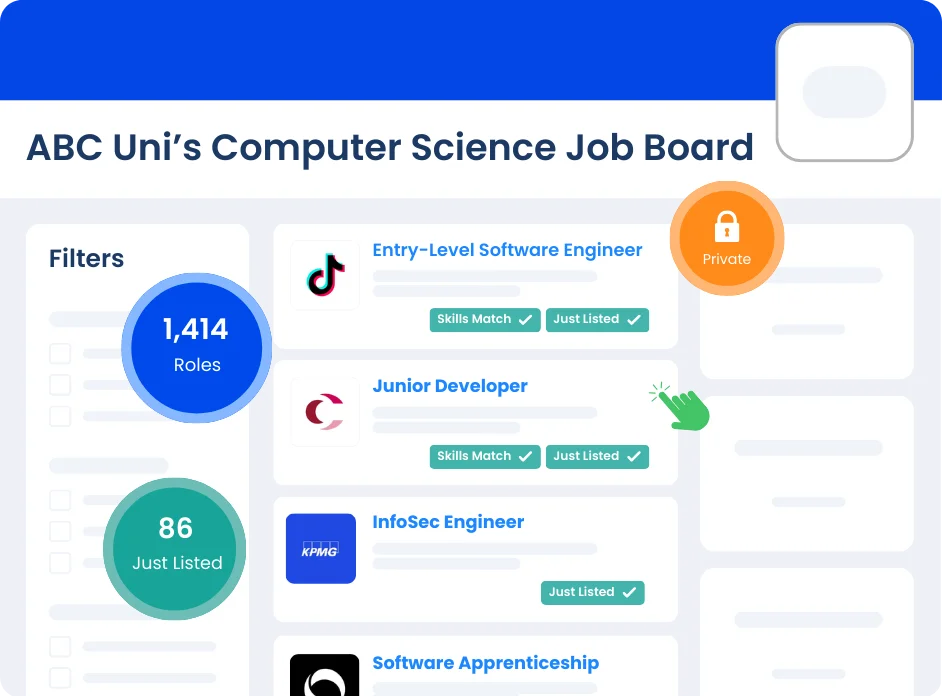
Spacewalk gives your careers service a private, branded institutional job board, so your team spends its time supporting students and graduates rather than curating job feeds.
Build your branded Spacewalk job board and invite your talent community in minutes
Whether you choose to stream roles automatically, invite employers or post them yourself they are automatically matched to your talent pool
Track applications, placements and community engagement from one reporting dashboard
Unlike generic job boards, Spacewalk gives you a branded, private or public jobs marketplace your talent actually trust, with sourcing, matching and reporting running automatically in the background.
Student and graduate personal data is regulated under the General Data Protection Regulation and the Data Protection Act 2018, with the Data Protection Commission acting as Ireland's supervisory authority (source: Data Protection Commission, Rules on electronic and direct marketing). Careers services should hold student data on a clear lawful basis, keep it only as long as needed for the service and outcome reporting and let students exercise their access and erasure rights.
Marketing careers events, employer opportunities or newsletters to alumni engages the ePrivacy Regulations 2011 (SI 336 of 2011), which require prior consent with a limited soft opt-in exception, and Article 21 of the GDPR gives every recipient the right to object to direct marketing at any time (source: Data Protection Commission, What rules apply to electronic direct marketing). Hiring employers remain responsible for right-to-work verification under the Employment Permits Act 2024, which requires a valid employment permit for non-EEA nationals unless they hold relevant immigration permission (source: Department of Enterprise, Trade and Employment, Who needs an employment permit). This is context, not legal advice.
This is an illustrative scenario, not a customer story. An Irish university careers service stands up a branded institutional board and invites its final-year cohort before results. Careers advisers watch an employer-direct feed match each student to live, still-open roles by discipline and location, and see application and interview activity for weaker-performing cohorts like Arts and Humanities. When the institution assembles its GOS narrative, the team exports landings by cohort rather than compiling screenshots at year end.
With cohort-level evidence. Spacewalk tracks registrations, applications, interviews and landings by cohort and discipline, so the GOS story is supported by real behavioural data rather than activity reports alone.
Because the roles are curated and employer-direct rather than re-listed from public platforms. Each student sees verified, active vacancies matched to their discipline, seniority and location, which a generic portal cannot offer.
Yes. Your students and graduates get a private, branded board that carries your institution's identity rather than a generic job site.
From an employer-direct job stream of verified, active roles with direct apply links, matched to each student's discipline, seniority and location. Vacancies are not scraped from job boards or aggregators.
Yes. You can invite employer partners to post vacancies to your board or view your talent community, keeping opportunities inside the institution.
Student data is held to enable the service and produce outcome reports, in line with the General Data Protection Regulation and the Data Protection Act 2018 under the oversight of the Data Protection Commission. Students can exercise their access, rectification and erasure rights, and direct marketing follows the ePrivacy Regulations 2011 and Article 21 GDPR.
For the full product overview, see university careers offices job board software, the main product page for university careers offices worldwide.
Spacewalk supports university careers services internationally, including university careers service job boards in the United Kingdom, university career center software in the United States and branded careers service boards for Australian universities.
Explore Spacewalk for Irish employability programmes, Irish outplacement providers, Irish professional associations and Irish summer school programmes.
