September 25, 2026
















Graduate employment is publicly benchmarked, and the numbers moved the wrong way: the undergraduate full-time employment rate fell to 74.0 per cent in 2024, down from 79.0 per cent in 2023, while undergraduate underemployment rose to 17.7 per cent (source: QILT, 2024 Graduate Outcomes Survey National Report, 2025). Because the Graduate Outcomes Survey benchmarks every institution four to six months after completion, a careers service is judged on a metric largely driven by the macro labour market, not by its own effort. What careers services can influence is access to genuine, still-open graduate-level roles.
The scale of the annual graduate pool is captured by the national Graduate Outcomes Survey: in 2024 it invited 335,153 recent graduates across all study levels and received 117,794 valid responses, a 38.5 per cent response rate, drawing on 130 higher education institutions including all 42 universities (source: QILT, 2024 Graduate Outcomes Survey National Report, 2025). Careers services are a private, institution-funded function with no separate market sizing, so the measure that matters is the graduate employment rate at four to six months after completion, published provider by provider in the same survey. For a careers service, the constraint is rarely demand, it is access to genuine, still-open graduate-level vacancies to move students into.
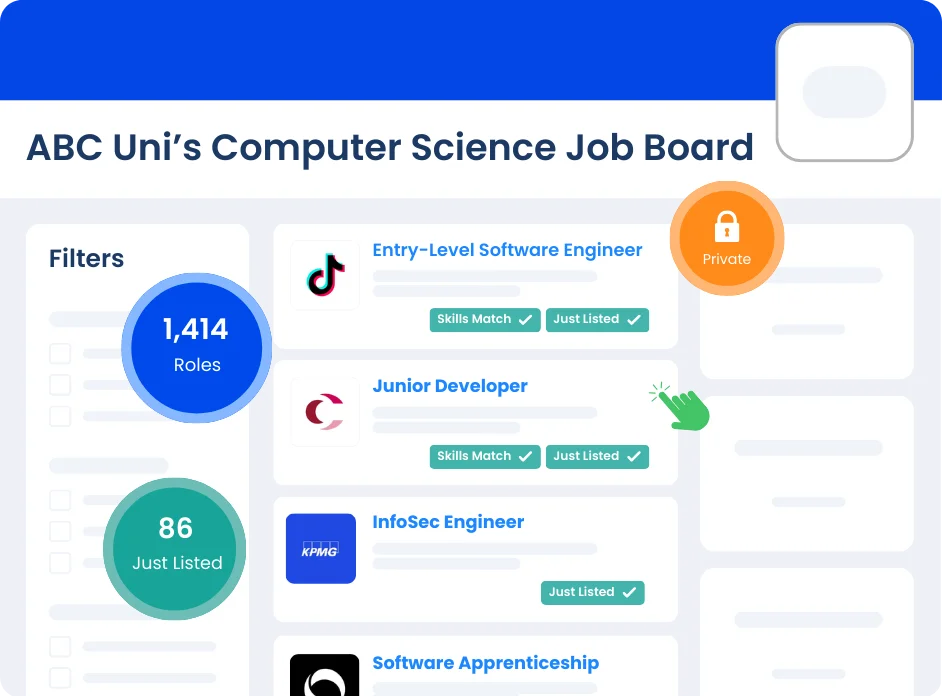
Spacewalk gives your careers service a private, branded job board, so your advisers spend their time coaching rather than trawling job boards.
Build your branded Spacewalk job board and invite your talent community in minutes
Whether you choose to stream roles automatically, invite employers or post them yourself they are automatically matched to your talent pool
Track applications, placements and community engagement from one reporting dashboard
Unlike generic job boards, Spacewalk gives you a branded, private or public jobs marketplace your talent actually trust, with sourcing, matching and reporting running automatically in the background.
Universities and most private providers handling student data are APP entities under the Privacy Act 1988, so the 13 Australian Privacy Principles apply. The Office of the Australian Information Commissioner expects open and transparent handling, collection and use limited to the stated purpose, and appropriate security of personal information, with APP 6 (use and disclosure) and APP 11 (security) the obligations a privacy officer will test on any platform holding student records (source: OAIC, Australian Privacy Principles).
Higher education providers are also registered and regulated by the Tertiary Education Quality and Standards Agency against the Higher Education Standards Framework, within which graduate outcomes and the student experience sit as part of the regulated quality picture (source: TEQSA, our role).
Verifying a graduate's right to work in Australia remains the hiring employer's responsibility, not the job board's, and student data should only ever be matched to genuine, employer-direct vacancies rather than passed to third-party aggregators. This is context, not legal advice.
This is an illustrative scenario, not a customer story. An Australian university careers service supporting a final-year cohort stands up a branded job board before graduation. Instead of emailing job links, advisers watch an employer-direct feed match each student to live, relevant graduate-level roles, and see application and interview activity per faculty. When the institution asks for evidence of employability activity, the careers service exports landings by cohort rather than assembling screenshots at the end.
Graduate outcomes are benchmarked nationally by the Graduate Outcomes Survey four to six months after completion. A job board your students actually use gives you application, interview and offer data per cohort, which is the foundation of your own employability evidence.
There is no target a careers service sets on its own. The national undergraduate full-time employment rate was 74.0 per cent in 2024, published provider by provider, so any credible claim rests on your own current cohort data.
Yes. Your careers service gets its own branded board where employer-direct live vacancies are matched to your students' skills and discipline, with every application tracked.
From an employer-direct stream of verified, active roles with direct apply links, matched to each student's skills, discipline and location. Your team can also post roles or invite employers to post, but the vacancies are not scraped from job boards or aggregators.
No. Right-to-work verification stays with the hiring employer. Spacewalk connects students to live vacancies and tracks their progress.
The Privacy Act 1988 and the Australian Privacy Principles. In practice that means transparent handling, using data only for the purpose collected and appropriate security for student records, in line with OAIC guidance.
For the full product overview, see university careers offices job board software, the main product page for university careers offices worldwide.
Spacewalk supports university careers services worldwide, including careers service job board software in the United Kingdom, university career center platforms in the United States and careers software for Canadian universities.
Explore Spacewalk for Australian alumni career platforms, Australian employability program providers, Australian skills bootcamps and Australian professional associations.
