September 25, 2026
















Canadian university enrolments are back on the way up. Postsecondary enrolments reached 2.3 million students in 2023/2024, a 5.8% year-on-year rise, with 1,152,105 of those enrolled at universities (source: Statistics Canada, Canadian postsecondary enrolments and graduates, 2023/2024). Every additional cohort adds to the pipeline a careers office is expected to support. At the same time youth (15-24) unemployment sat at 12.7% in June 2026, roughly double the 6.5% national headline rate (source: Statistics Canada, Labour Force Survey, June 2026). The pressure to move graduates into work is real, and it lands on the careers office.
Canada's postsecondary system is large and growing. Total enrolments hit 2.3 million students in 2023/2024, up 5.8% year on year, split between 1,152,105 at universities and 611,718 at colleges, with 284,160 international students at universities and a further 288,801 at colleges (source: Statistics Canada, Canadian postsecondary enrolments and graduates, 2023/2024). Graduate outcomes are uneven, with recent StatCan earnings data showing a wide spread by field of study (source: Statistics Canada, Bachelor's Degree Programs and Pay, 2020). For a careers office the constraint is rarely audience size, it is access to genuine, still-open roles matched to each student's discipline.
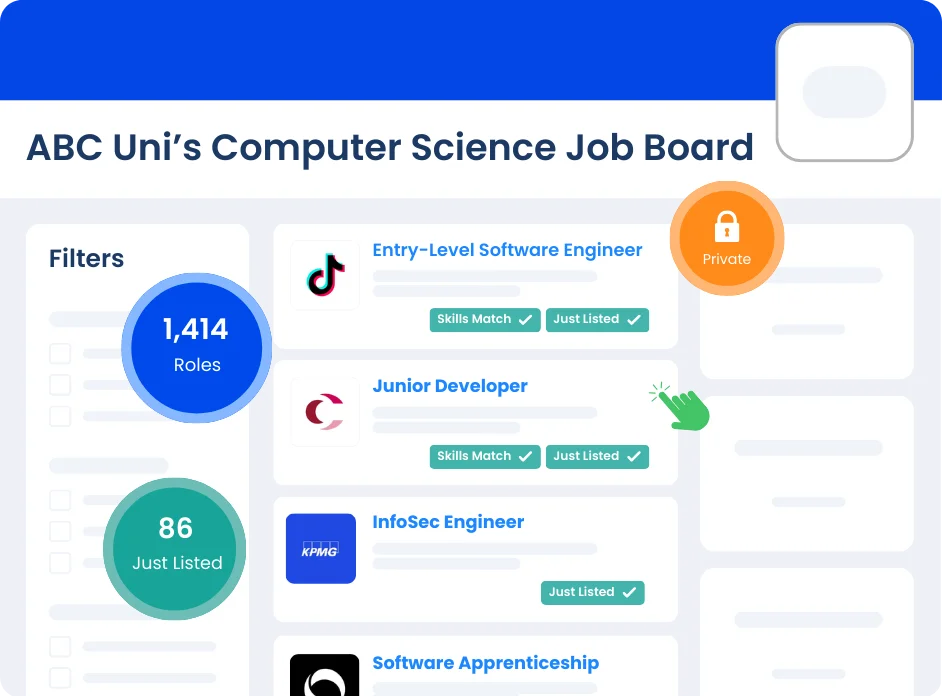
Spacewalk gives your careers office a private, branded job board, so your team spends time coaching students rather than curating listings from public boards.
Build your branded Spacewalk job board and invite your talent community in minutes
Whether you choose to stream roles automatically, invite employers or post them yourself they are automatically matched to your talent pool
Track applications, placements and community engagement from one reporting dashboard
Unlike generic job boards, Spacewalk gives you a branded, private or public jobs marketplace your talent actually trust, with sourcing, matching and reporting running automatically in the background.
Privacy coverage for a Canadian university depends on the province. Public universities are covered by provincial public-sector legislation such as Ontario's FIPPA or British Columbia's FIPPA, and private-sector partners handling student data operate under PIPEDA or, in Alberta, British Columbia and Quebec, a substantially similar provincial private-sector law (source: Office of the Privacy Commissioner of Canada, Provincial and territorial privacy laws and oversight). Quebec's Law 25 adds stricter consent and cross-border transfer expectations that a Quebec-based careers office needs to plan for.
Hiring itself stays with the employer, so right-to-work and eligibility checks sit with the hiring organisation rather than the careers office or the board provider. Direct marketing to students and alumni engages the anti-spam law (CASL) when messages are commercial electronic messages. This is context, not legal advice.
This is an illustrative scenario, not a customer story. A Canadian university careers office stands up a branded board and invites final-year students by faculty. Instead of forwarding job links, advisers watch an employer-direct feed match each student to live, discipline-relevant roles, and see application and interview activity by faculty and by field of study. When the institution asks for evidence of career support, the team exports landings by cohort rather than assembling screenshots at year end.
With cohort-level data. Spacewalk tracks registrations, board usage, applications, interviews and landings by faculty and field of study, so your team can show what happened to graduates rather than reporting engagement activity alone.
Because the roles are curated and employer-direct rather than re-listed from public platforms. Each student sees verified, active vacancies matched to their programme, seniority and location, which a generic board cannot offer.
Yes. Your students and alumni get their own branded board, so the experience carries your institution's brand rather than a generic job site.
From an employer-direct stream of verified, active roles with direct apply links. Your team can also post roles or invite employer partners to post, and vacancies are not scraped from job boards or aggregators.
No. Right-to-work verification stays with the hiring employer. Spacewalk connects students to live vacancies and tracks their progress.
It depends on the province. Public universities are typically covered by provincial public-sector FIPPA legislation, and private-sector partners fall under PIPEDA or a substantially similar provincial private-sector law in Alberta, British Columbia and Quebec. Quebec's Law 25 adds stricter consent and cross-border transfer expectations.
For the full product overview, see university careers offices job board software, the main product page for university careers offices worldwide.
Spacewalk supports university careers offices worldwide, including university careers service software in the United Kingdom, university careers office platforms for Australian institutions and university career center software in the United States.
Explore Spacewalk for Canadian college careers offices, Canadian alumni networks, Canadian skills bootcamps and Canadian outplacement services.
