September 28, 2026
















Canada's labour market carries persistent unfilled demand. Employers reported 506,700 job vacancies in the first quarter of 2026, with a national vacancy rate of 2.8% and the first quarterly rise in vacancies since Q2 2022 (source: Statistics Canada, Job Vacancy and Wage Survey, Q1 2026). At the same time the national unemployment rate sat at 6.5% in June 2026 and youth (15-24) unemployment reached 12.7%, roughly double the headline rate (source: Statistics Canada, Labour Force Survey, June 2026). Bootcamp providers sit in the middle of that gap, moving learners into real vacancies rather than reporting seats filled.
Canada's short-cycle skills training sector is provincially fragmented and works alongside a national labour market that keeps producing openings faster than qualified applicants. Employers reported 506,700 vacancies in Q1 2026 at a 2.8% vacancy rate (source: Statistics Canada, Job Vacancy and Wage Survey, Q1 2026). The unemployment picture is uneven, with the headline rate at 6.5% in June 2026 and youth unemployment at 12.7% (source: Statistics Canada, Labour Force Survey, June 2026). For a bootcamp provider the constraint is rarely learner interest, it is access to verified, still-open roles that match what each cohort was trained for.
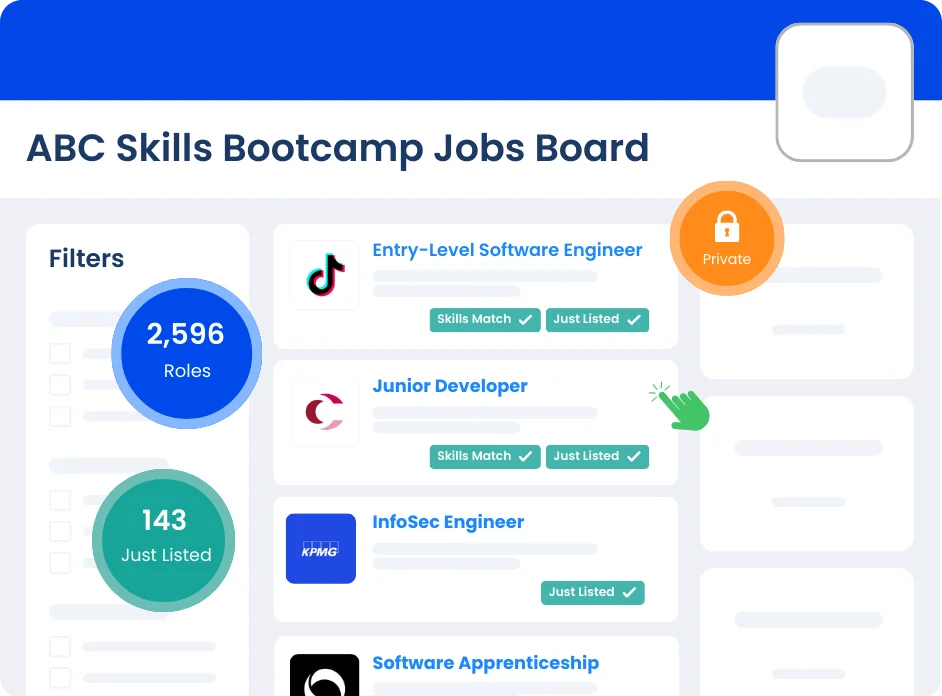
Spacewalk gives your bootcamp a private, branded job board so learners land in real vacancies matched to what they were trained for, not scraped listings.
Build your branded Spacewalk job board and invite your talent community in minutes
Whether you choose to stream roles automatically, invite employers or post them yourself they are automatically matched to your talent pool
Track applications, placements and community engagement from one reporting dashboard
Unlike generic job boards, Spacewalk gives you a branded, private or public jobs marketplace your talent actually trust, with sourcing, matching and reporting running automatically in the background.
Canadian private-sector data-protection rules split by province. The federal Personal Information Protection and Electronic Documents Act (PIPEDA) applies to private-sector organisations across most of the country, and Alberta, British Columbia and Quebec have substantially similar private-sector laws that apply in place of PIPEDA within their provinces (source: Office of the Privacy Commissioner of Canada, Provincial and territorial privacy laws and oversight). Quebec's Law 25 introduces stricter consent and cross-border transfer expectations that a Quebec-serving bootcamp must plan for.
Hiring itself remains with the employer. Roles matched through your board should be genuine, employer-direct vacancies with direct apply links, and right-to-work verification stays with the hiring employer under federal and provincial employment law. This is context, not legal advice.
This is an illustrative scenario, not a customer story. A Canadian coding and data bootcamp with cohorts in Ontario and British Columbia stands up a branded board and invites learners at intake. Instead of emailing job links, coaches watch an employer-direct feed match each learner to live, cohort-relevant roles and see application and interview activity by programme. When the provincial funder asks for outcomes, the team exports landings by cohort rather than assembling screenshots at term end.
With cohort-level data. Spacewalk tracks registrations, board usage, applications, interviews and landings by cohort and by province, so your team can report what happened to learners rather than reporting seats filled.
Because the roles are curated and employer-direct, matched to what each learner was trained for. Each learner sees verified, active vacancies matched to their programme, seniority and location, which a generic board cannot offer.
Yes. Your cohort gets its own branded board, so learners experience your bootcamp's brand rather than a generic job site.
From an employer-direct stream of verified, active roles with direct apply links. Your team can also post roles or invite employer partners to post, and vacancies are not scraped from job boards or aggregators.
No. Right-to-work verification stays with the hiring employer under federal and provincial employment law. Spacewalk connects learners to live vacancies and tracks their progress.
It depends on where you operate. PIPEDA applies federally, and Alberta, British Columbia and Quebec have substantially similar private-sector laws that apply in place of PIPEDA within their provinces. Quebec's Law 25 adds stricter consent and cross-border transfer expectations.
For the full product overview, see skills bootcamps job board software, the main product page for skills bootcamps worldwide.
Spacewalk supports short-cycle skills training providers worldwide, including Skills Bootcamp job board software for UK providers, skills bootcamp platforms for Australian providers and skills bootcamp job board software in the United States.
Explore Spacewalk for Canadian college careers offices, Canadian university careers offices, Canadian adult education providers and Canadian outplacement services.
