September 25, 2026














In Program Year 2024, the core WIOA programs served over 2.7 million participants, a 3.2 percent increase on the year before (source: US Department of Labor, PY 2024 WIOA National Summary Narrative, 2025), and more than 70,000 eligible training programs now compete for those training dollars on the federal comparison site (source: US Department of Labor, TrainingProviderResults.gov, 2026). For a bootcamp or workforce training provider, funding follows measured job outcomes, and those outcomes are published by program and by local board. What providers cannot manufacture is a steady supply of genuine, still-open vacancies to move each graduate into.
US workforce training runs at scale. The WIOA Adult, Dislocated Worker, Youth and Wagner-Peyser programs served over 2.7 million participants in Program Year 2024 (source: US Department of Labor, WIOA performance results, 2025), and more than 70,000 eligible training programs are listed federally, having served over 7.8 million individuals since 2021 (source: US Department of Labor, TrainingProviderResults.gov, 2026). Registered apprenticeship is expanding alongside, with over 363,000 new apprentices started since January 2025 against a stated goal of one million (source: US Department of Labor, news release, 2026). Demand is there: BLS counted 7.6 million job openings in May 2026 (source: US Bureau of Labor Statistics, JOLTS, 2026). For a provider, the constraint is rarely demand, it is access to genuine, still-open vacancies to place people into.
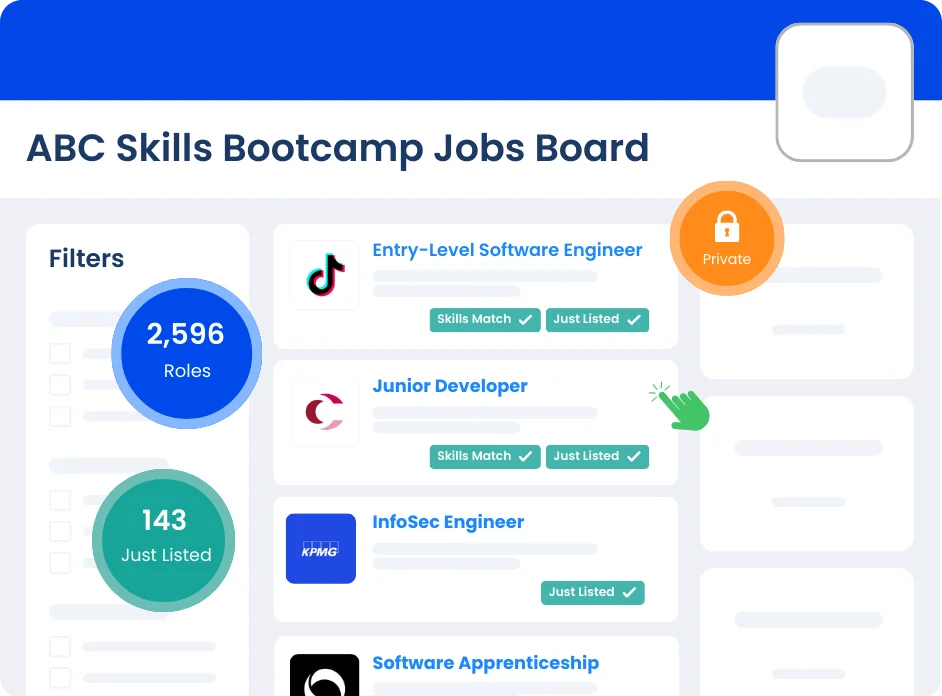
Spacewalk gives each cohort a private, branded job board, so your coaches spend their time coaching rather than trawling job boards.
Build your branded Spacewalk job board and invite your talent community in minutes
Whether you choose to stream roles automatically, invite employers or post them yourself they are automatically matched to your talent pool
Track applications, placements and community engagement from one reporting dashboard
Unlike generic job boards, Spacewalk gives you a branded, private or public jobs marketplace your talent actually trust, with sourcing, matching and reporting running automatically in the background.
Under WIOA Section 116, states and local areas are assessed on six primary indicators, including employment in the second and fourth quarters after exit, median earnings, credential attainment and measurable skill gains, certified annually in the Statewide Performance Report (source: US Department of Labor, WIOA performance indicators, 2025). From PY 2024, Retention with the Same Employer is a formal indicator under the Effectiveness in Serving Employers final rule (source: US Department of Labor, PY 2024 WIOA National Summary Narrative, 2025).
For Title IV programs, the Education Department's June 2026 earnings-accountability final rule ties Direct Loan eligibility to graduates earning more than a typical high school diploma holder (source: US Department of Education, press release, 2026). Hiring and eligibility checks remain the employer's responsibility, and participant data should only ever be matched to genuine, employer-direct vacancies rather than passed to third-party aggregators. This is context, not legal advice.
This is an illustrative scenario, not a customer story. A US workforce training provider running a 150-person tech cohort stands up a branded job board at enrollment. Instead of emailing job links, coaches watch an employer-direct feed match each person to live, relevant roles, and see application and interview activity per cohort. When it is time to report employment in the second and fourth quarters after exit, the provider exports placements by cohort rather than chasing screenshots at the end.
With participant-level data. WIOA pays on measured employment in the second and fourth quarters after exit, so a job board your graduates actually use gives you application, interview and placement data per person, which is the foundation of your reported outcomes.
Employment in the second and fourth quarters after exit is the core measure, alongside median earnings, credential attainment and measurable skill gains. From PY 2024, retention with the same employer is also a scored indicator.
Start vacancy matching early. Because the measures track employment within roughly six months of exit, providers who leave job search to the final weeks compress the entire outcome window into too little time.
Yes. With Retention with the Same Employer now a primary indicator, durable placements into genuine roles with real employers count for more than churn placements. Employer-direct, active vacancies support that.
Yes. Spacewalk gives your program a branded board where employer-direct live vacancies are matched to your graduates' new skills, with every application tracked.
At least through the fourth quarter after exit, because that is the outcome window. Automated engagement tracking means the data keeps accruing without your team chasing resumes and screenshots.
For the full product overview, see skills bootcamps job board software, the main product page for skills bootcamps worldwide.
Spacewalk supports skills bootcamps and workforce training providers worldwide, including job board software for UK skills bootcamps, job placement platforms for Australian bootcamps and bootcamp job board software for Canadian providers.
Explore Spacewalk for US adult education providers, US employability programs, US university career centers and US professional associations.
