September 25, 2026












In program year 2023-24, 1,261,601 adults took part in AEFLA-funded (WIOA Title II) adult education programs nationally (source: US Department of Education, NRS Aggregate Table 3, 2025), yet only 33.21 percent of exiters were employed in the second quarter after exit against a 46.76 percent measurable skill gains rate (source: US Department of Education, NRS Aggregate Table 5, 2025). Learners gain skills at a much higher rate than they convert those skills into jobs, and that transition-to-employment gap is the weakest link in the funnel.
Adult education in the United States is delivered largely through AEFLA, Title II of the Workforce Innovation and Opportunity Act, which the Department of Education calls the largest federal investment in adult education and literacy (source: US Department of Education, OCTAE, About AEFLA, 2026). In program year 2023-24, 2,046 local organizations received Title II funds, spanning local education agencies, community and technical colleges, community-based organizations and correctional institutions, with $659.3 million in federal funds matched by $1.33 billion in state funds (source: US Department of Education, NRS Aggregate Table 14, 2025). The fastest-growing segment is IELCE, whose enrollment grew 72 percent in a single year to 308,150 (source: US Department of Education, OCTAE IELCE Report to Congress, 2025). For providers, the constraint is rarely demand, it is converting learners into reportable, unsubsidized jobs.
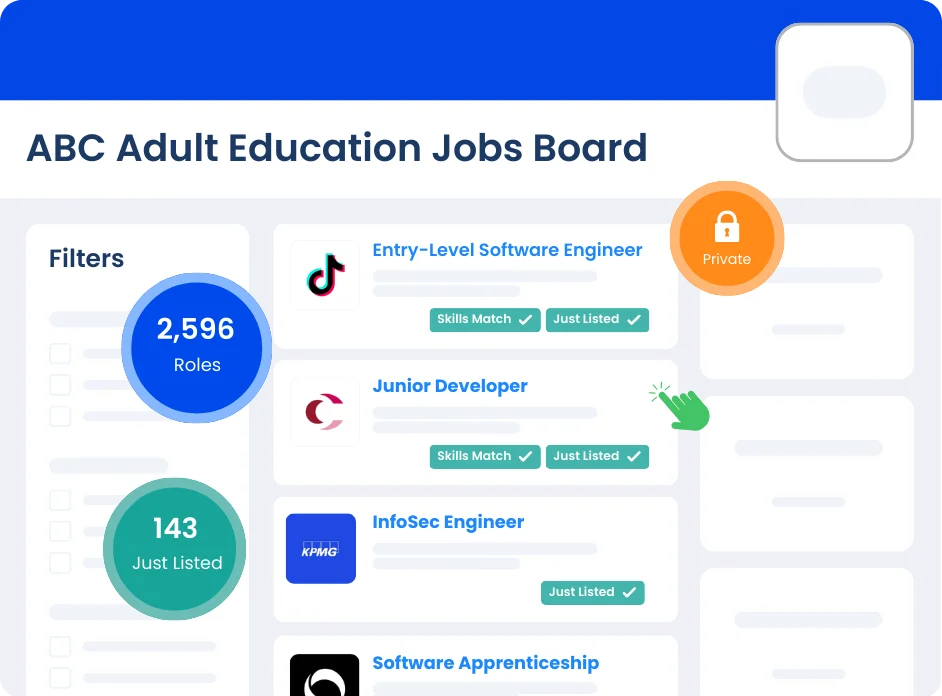
Spacewalk gives your program a branded job board, so instructors and career staff spend their time supporting learners rather than trawling listings for live vacancies.
Build your branded Spacewalk job board and invite your talent community in minutes
Whether you choose to stream roles automatically, invite employers or post them yourself they are automatically matched to your talent pool
Track applications, placements and community engagement from one reporting dashboard
Unlike generic job boards, Spacewalk gives you a branded, private or public jobs marketplace your talent actually trust, with sourcing, matching and reporting running automatically in the background.
Adult education providers reporting under AEFLA feed participant outcomes into the National Reporting System, the mandatory outcome-based accountability system for the program, where a participant is defined as an individual with at least 12 contact hours (source: US Department of Education, OCTAE, National Reporting System, 2026). WIOA Section 116 sets six primary indicators of performance, including employment rate in the second and fourth quarters after exit, median earnings, credential attainment and measurable skill gains, with employment measured as unsubsidized employment (source: US Department of Education, OCTAE, AEFLA Accountability, 2026).
Employment eligibility verification, including Form I-9, remains the hiring employer's responsibility, not the job board's, and learner data should only ever be matched to genuine, employer-direct vacancies rather than passed to third-party aggregators. This is context, not legal advice.
This is an illustrative scenario, not a customer story. An adult education provider running an IELCE cohort of 150 learners stands up a branded job board at enrollment. Instead of emailing job links, career staff watch an employer-direct feed match each learner to live, relevant roles, and see application and interview activity per cohort. When the state asks for outcome evidence, the provider exports landings by cohort rather than assembling screenshots at the end.
WIOA Section 116 measures employment in the second and fourth quarters after exit, median earnings, credential attainment and measurable skill gains. A job board your learners actually use gives you application, interview and landing data per learner, which is the foundation of the outcome evidence that rolls into your state report.
Nationally, 46.76 percent of participants achieved a measurable skill gain in program year 2023-24 but only 33.21 percent of exiters were employed two quarters after exit. Learners gain skills faster than they convert them into jobs, which is exactly the transition gap a live vacancy pipeline is meant to close.
Yes. Section 243 providers are required to place adults in unsubsidized, in-demand jobs and to integrate with the local workforce system. Matching learners to employer-direct vacancies and tracking the result supports that statutory placement obligation.
From an employer-direct stream of verified, active roles with direct apply links, matched to each learner's skills and location. Your team can also post roles or invite employers to post, but the vacancies are not scraped from job boards or aggregators.
Yes. Each cohort or campus gets its own branded board, so the experience carries your program's brand rather than a generic job site.
Through the WIOA measurement windows, which reach into the fourth quarter after exit. Automated engagement tracking means the data keeps accruing without your team chasing resumes and screenshots.
For the full product overview, see adult education providers job board software, the main product page for adult education providers worldwide.
Spacewalk supports adult education and lifelong learning providers worldwide, including adult education job board software in the United Kingdom, adult and community education platforms for Australian providers and adult learning software for Canadian providers.
Explore Spacewalk for US skills bootcamps, US employability programs, US university career centers and US professional associations.
