September 24, 2026









Community colleges and 4-year colleges sell completion on career outcomes, and the earnings case is real. Median usual weekly earnings in 2024 were $1,543 for bachelor's degree holders and $1,099 for associate degree holders, against $930 for workers with only a high school diploma (source: US Bureau of Labor Statistics, Education pays, 2024). The gap between that promise and each graduate's first job is where the career center lives. Among 20- to 29-year-olds who earned a bachelor's degree in 2024, 69.6 percent were employed in October, alongside 78.1 percent of recent associate degree recipients (source: US Bureau of Labor Statistics, College Enrollment and Work Activity of Recent High School and College Graduates, 2025).
Total undergraduate enrollment in US degree-granting institutions was 15.4 million students in fall 2021. The 10.8 million students at 4-year institutions made up 70 percent of the total, with the remaining 4.7 million enrolled at 2-year institutions (source: National Center for Education Statistics, Undergraduate Enrollment, Condition of Education, 2023). The pipeline keeps refilling. In October 2024, 62.8 percent of that year's high school graduates ages 16 to 24 were already enrolled in colleges or universities (source: US Bureau of Labor Statistics, College Enrollment and Work Activity of Recent High School and College Graduates, 2025). For a career center, the constraint is rarely the size of the student body. It is access to genuine, still-open roles to place students and graduates into.
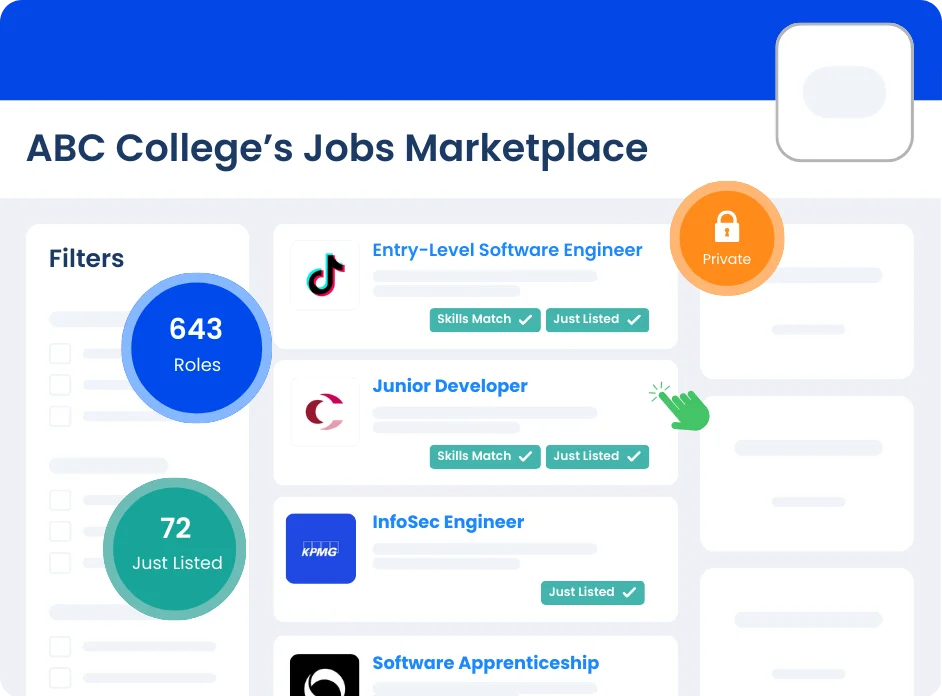
Spacewalk gives your college a private, branded job board, so career center staff spend their time advising students rather than trawling job boards.
Build your branded Spacewalk job board and invite your talent community in minutes
Whether you choose to stream roles automatically, invite employers or post them yourself they are automatically matched to your talent pool
Track applications, placements and community engagement from one reporting dashboard
Unlike generic job boards, Spacewalk gives you a branded, private or public jobs marketplace your talent actually trust, with sourcing, matching and reporting running automatically in the background.
Career centers sit inside institutions covered by FERPA, the federal law that gives rights of access, amendment and control over the disclosure of personally identifiable information from education records. Those rights belong to the student personally once they enter a postsecondary institution at any age (source: US Department of Education, What is FERPA). Any career platform handling student records should be assessed against those obligations.
Hiring rules bind the employers on your board too. Federal law makes it illegal to publish a job ad that shows a preference for or discourages applicants based on protected characteristics, and the EEOC notes that even an ad seeking "recent college graduates" may discourage people over 40 from applying (source: EEOC, Prohibited Employment Policies and Practices). Employer-direct, verified roles make problem listings easier to catch. This is context, not legal advice.
This is an illustrative scenario, not a customer story. A community college career center stands up a branded job board and invites its graduating and continuing students. Instead of forwarding job links by email, advisors watch an employer-direct feed match each student to live local roles that fit class schedules and fields of study. When institutional research asks for first-destination evidence, the center exports applications, interviews and landings by cohort rather than chasing graduates with surveys.
With student-level data. Spacewalk tracks registrations, board usage, applications, interviews and landings by cohort, so your center can show what happened to students rather than reporting appointment counts alone.
Because the roles are curated and employer-direct rather than re-listed from public platforms. Each student sees verified, active vacancies matched to their field of study, experience level and location.
Yes. Boards can be organized by program, campus or cohort, and matching handles part-time, local and entry-level roles that suit students who are studying and working at the same time.
From an employer-direct stream of verified, active roles with direct apply links. Your team can also post roles or invite local employers to post, but vacancies are not scraped from job boards or aggregators.
Yes. Your students get a private board that carries your college's brand, with member invites controlled by your career center and no public access.
No. Employment eligibility verification stays with the hiring employer. Spacewalk connects students to live vacancies and tracks their progress through to hire.
For the full product overview, see college careers offices job board software, the main product page for college careers offices worldwide.
Spacewalk supports campus career services worldwide, including career center job board software for Canadian colleges, careers service platforms for UK universities and university careers office software in Australia.
Explore Spacewalk for US university career services, US alumni networks, US skills bootcamps and US adult education providers.
