September 28, 2026











Career centers are judged on first-destination outcomes, yet the outcomes are getting harder to prove. For the college Class of 2024, the national bachelor's knowledge rate, the share of graduates for whom a verified destination is known, was just 55.0 percent, below the 65 percent minimum that the sector body recommends (source: NACE, First Destinations for the College Class of 2024, November 2025; standard from NACE, FDS Standards and Protocols, September 2025). The headline career outcomes rate for that class was 85.7 percent employed or in continuing education within six months (source: NACE, Class of 2024 outcomes, 2025), but a number that strong only holds up if the underlying destination data does.
The scale is large and steady. US postsecondary institutions conferred more than 4.1 million degrees in 2021-22, including 2,015,035 bachelor's degrees (source: NCES, Digest of Education Statistics 2023, Table 318.10), and nearly 19 million students were enrolled in fall 2022 across about 3,900 degree-granting institutions (source: NCES, Fast Facts, fall 2022; NCES, Digest 2023, Table 317.10, 2022-23). Career centers do not lack graduates to serve; the constraint is connecting each one to genuine, still-open roles and capturing the destination. Value framing is well established: graduating seniors who used at least one career service averaged 1.24 job offers versus 1.0 for those who used none (source: NACE, the value of career services, 2022 Student Survey).
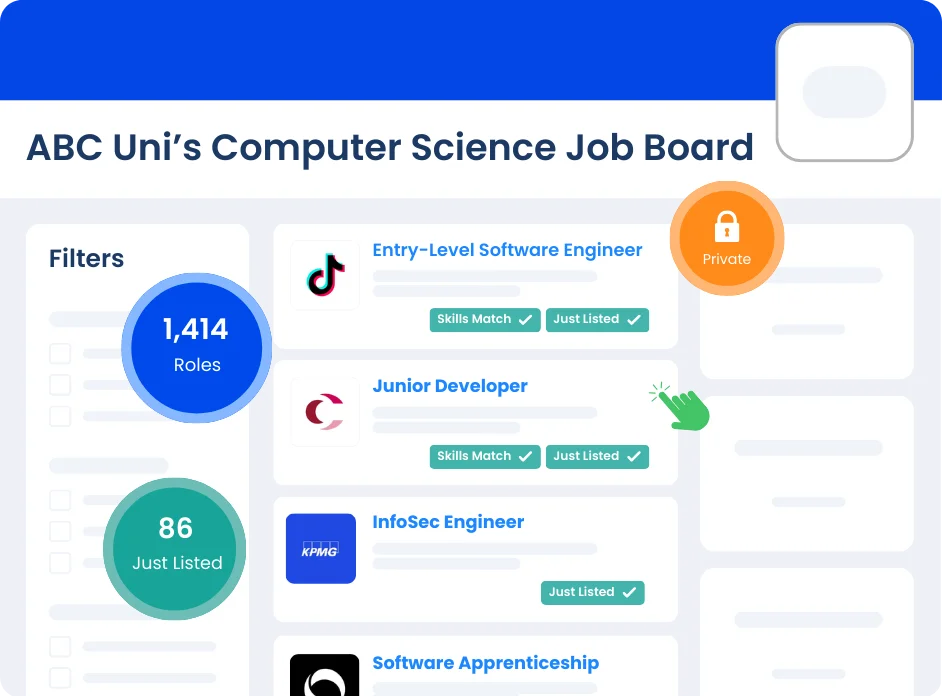
Spacewalk gives your institution a private, branded job board, so your advisors spend their time coaching rather than trawling job boards.
Build your branded Spacewalk job board and invite your talent community in minutes
Whether you choose to stream roles automatically, invite employers or post them yourself they are automatically matched to your talent pool
Track applications, placements and community engagement from one reporting dashboard
Unlike generic job boards, Spacewalk gives you a branded, private or public jobs marketplace your talent actually trust, with sourcing, matching and reporting running automatically in the background.
Career center records about students are education records under FERPA (the Family Educational Rights and Privacy Act, 20 U.S.C. 1232g; 34 CFR Part 99), which gives eligible students rights over the disclosure of personally identifiable information and applies to any institution receiving US Department of Education program funds (source: US Department of Education, what is FERPA).
An outside platform may be treated as a "school official" and receive student records without separate consent only if it performs an institutional function, stays under the institution's direct control over the use and maintenance of those records, uses the data only for the intended purpose and does not redisclose it (34 CFR 99.31(a)(1)(i)(B)) (source: US Department of Education, who is a school official under FERPA). Employment eligibility verification stays with the hiring employer, not the job board. This is context, not legal advice.
This is an illustrative scenario, not a customer story. A US university career center opens a branded job board for its graduating class and invites students before commencement. Instead of pointing students at general job sites, advisors watch an employer-direct feed match each student to live, relevant roles, and see application and interview activity by school. When first-destination reporting comes due, the center exports known destinations by cohort rather than chasing survey responses at the deadline.
By capturing outcomes as they happen. Spacewalk tracks registrations, applications, interviews and landings per student, so verified destinations accrue through the platform instead of being reconstructed from surveys after graduation.
The recognized sector body recommends a minimum of 65 percent. The national bachelor's knowledge rate for the Class of 2024 was 55.0 percent, so most institutions have room to improve, and better destination data is how they close the gap.
Yes. Each board carries your institution's or school's brand rather than a generic job site, and you can run separate boards by college or graduating cohort.
From an employer-direct stream of verified, active roles with direct apply links, matched to each student's skills, level and location. Your team can also post roles or invite employers to post, but the vacancies are not scraped from job boards or aggregators.
No. Employment eligibility verification stays with the hiring employer. Spacewalk connects students to live vacancies and tracks their progress.
Where the platform touches student records, it is designed to operate under the FERPA school-official exception: performing an institutional function under your direct control, using data only for the intended purpose and not redisclosing it. This is context, not legal advice.
For the full product overview, see university careers offices job board software, the main product page for university careers offices worldwide.
Spacewalk supports university careers and career services teams worldwide, including careers service job board software in the United Kingdom, university careers platforms in Australia and career centre software for Canadian institutions.
Explore Spacewalk for US alumni career networks, US employability programs, US coding and skills bootcamps and US professional associations.
