August 1, 2026














New Zealand has eight universities, and each is under growing pressure to show a genuine employment picture for its graduates. Over 43,000 students graduate from NZ universities every year, 90 percent at bachelor's degree level and above, and TEC publishes provider-level post-study destinations and earnings measured 1, 3, 5, 7 and 9 years after graduation, so outcomes are traceable back to your institution (sources: Universities New Zealand, Key facts about the university sector, 2024; TEC, Data on post-study outcomes for tertiary education graduates, 2026). The wider labour market has softened at the same time, with seasonally adjusted unemployment at 5.3 percent in the September 2025 quarter and the NEET rate for 15 to 24 year olds rising to 13.8 percent (source: Stats NZ, Labour market statistics September 2025 quarter, 2025).
New Zealand has eight universities that together contribute around 1.2 percent of GDP, with total sector expenditure of about NZ$3.5 billion (source: Universities New Zealand, Key facts about the university sector, 2024). Formal tertiary enrolments totalled 399,685 in 2024, easing to 395,095 in 2025, while international enrolments grew from 52,145 to 59,890 across the same period (source: Education Counts, Tertiary participation, 2025). Graduate outcomes are visible at provider level through TEC's post-study destinations and earnings data and through the Universities NZ Graduate Outcomes tool covering the 2015 to 2021 cohorts for up to seven years, which together form the sector's core evidence base for whether a degree leads to work (source: Universities New Zealand, Graduate Outcomes tool, 2024).
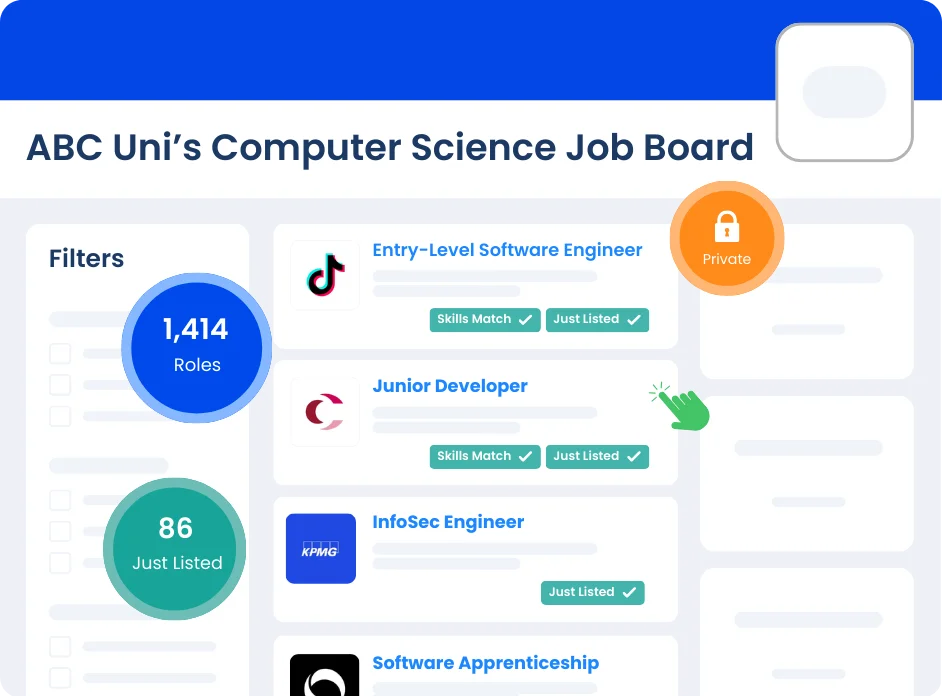
Spacewalk gives your institution a private, branded graduate job board, so advisers focus on students and employer relationships rather than moderating listings.
Build your branded Spacewalk job board and invite your talent community in minutes
Whether you choose to stream roles automatically, invite employers or post them yourself they are automatically matched to your talent pool
Track applications, placements and community engagement from one reporting dashboard
Unlike generic job boards, Spacewalk gives you a branded, private or public jobs marketplace your talent actually trust, with sourcing, matching and reporting running automatically in the background.
Graduate and applicant information is regulated by the Privacy Act 2020 and its 13 Information Privacy Principles, administered by the Office of the Privacy Commissioner (source: Office of the Privacy Commissioner, Privacy Act 2020 principles, 2026). From 1 May 2026 a new principle, IPP 3A, adds a notification obligation when personal information is collected about a person from someone other than the person themselves, which affects any workflow that ingests student or graduate data from a faculty, an alumni system or an employer partner (source: Office of the Privacy Commissioner, Privacy Act 2020 principles, 2026).
When careers services introduce graduates to employers, OPC recruitment guidance expects applicant information to stay with people directly involved, referees to be contacted only with consent and unsuccessful applications to be securely destroyed unless the graduate agrees you can keep them on file (source: Office of the Privacy Commissioner, Privacy in recruitment). Right-to-work verification stays with the hiring employer. This is context, not legal advice.
This is an illustrative scenario, not a customer story. A New Zealand university careers service stands up a branded graduate board and invites the graduating cohort before results are released. Instead of emailing job links, advisers watch an employer-direct feed match each graduate to live, relevant roles by discipline, and see application and interview activity by faculty. When the institution reports on employability, the team exports landings by cohort as internal evidence to sit alongside TEC destinations data rather than assembling screenshots at year end.
With graduate-level activity data. Spacewalk tracks registrations, applications, interviews and landings by cohort or faculty, so your team can show what happened to graduates in the months after finishing, ahead of TEC's longer post-study measurement points.
Because the roles are curated and employer-direct rather than re-listed from public platforms. Each graduate sees verified, active vacancies matched to their discipline, seniority and location, which a generalist board cannot offer.
Yes. Your careers service gets its own branded board, so the experience carries your institution's identity rather than a generic job site.
From an employer-direct stream of verified, active roles with direct apply links, matched to each graduate's discipline, seniority and location. Your team can also post roles or invite employers to post, but the vacancies are not scraped from job boards or aggregators.
No. Right-to-work verification stays with the hiring employer. Spacewalk connects graduates to live vacancies and tracks their progress.
The Privacy Act 2020 and its 13 Information Privacy Principles apply, with IPP 3A adding an indirect-collection notification obligation from 1 May 2026. The Office of the Privacy Commissioner also publishes recruitment-specific guidance on applicant information, referees and destruction of unsuccessful applications.
For the full product overview, see university careers offices job board software, the main product page for university careers offices worldwide.
Spacewalk supports university careers services worldwide, including Australian university careers offices, UK university careers services and Canadian university careers services.
Explore Spacewalk for New Zealand summer school programmes, New Zealand private training establishments, New Zealand employability programmes and New Zealand professional associations.
