September 25, 2026












People join professional networking groups for career value, and American careers give them plenty of occasions to need it. Workers born in 1957-64 held an average of 12.9 jobs between ages 18 and 58, with over 40 percent of those jobs held before age 25 (source: US Bureau of Labor Statistics, Number of Jobs and Labor Market Experience for Those Born 1957-1964, 2025). The churn has not stopped. In May 2026 alone, 3.1 million Americans quit a job (source: US Bureau of Labor Statistics, Job Openings and Labor Turnover Summary, May 2026). Every one of those moves is a moment a group either helps a member or gets forgotten by one.
The American labor market stays in constant motion even when headline unemployment is low. In June 2026 the unemployment rate was 4.2 percent, with 7.1 million people unemployed (source: US Bureau of Labor Statistics, The Employment Situation, June 2026). Underneath that headline, employers were advertising 7.6 million open positions and making 5.2 million hires a month (source: US Bureau of Labor Statistics, Job Openings and Labor Turnover Summary, May 2026). Millions of members of professional communities are somewhere in that flow at any moment. For a networking group, the constraint is not member appetite for career help. It is access to genuine, still-open roles worth putting in front of them.
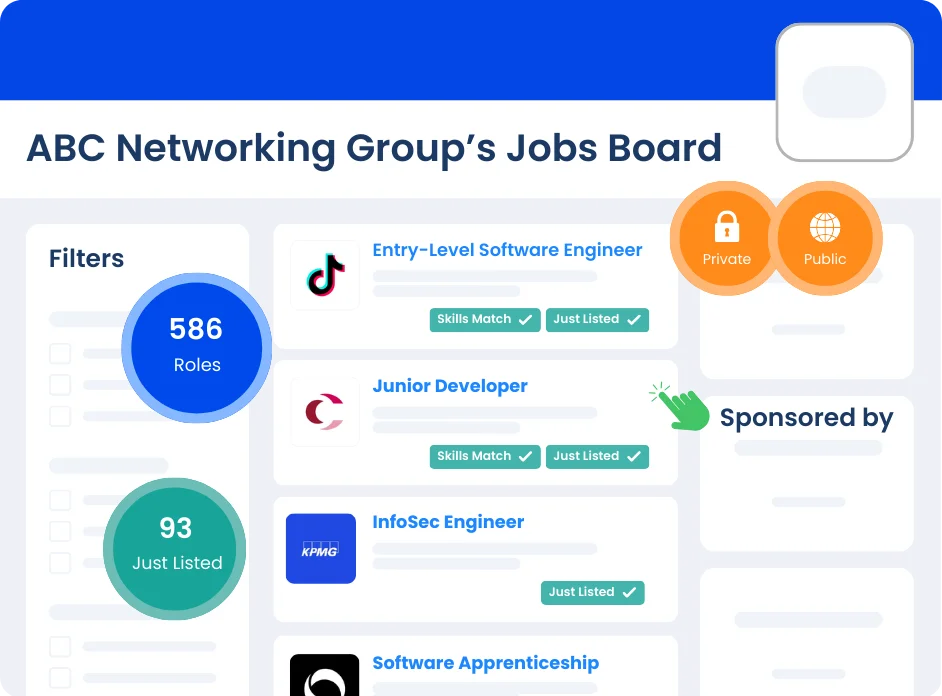
Spacewalk gives your community a private, branded job board, so organizers spend their time building the network rather than trawling job boards.
Build your branded Spacewalk job board and invite your talent community in minutes
Whether you choose to stream roles automatically, invite employers or post them yourself they are automatically matched to your talent pool
Track applications, placements and community engagement from one reporting dashboard
Unlike generic job boards, Spacewalk gives you a branded, private or public jobs marketplace your talent actually trust, with sourcing, matching and reporting running automatically in the background.
There is no single federal privacy statute covering member data, so state law does the work. The strictest baseline is California's CCPA, which gives residents rights to know what personal information an organization collects, to delete it, to correct it and to opt out of its sale or sharing (source: California Department of Justice, California Consumer Privacy Act). Emailing roles to members is commercial email under CAN-SPAM, which requires accurate headers, a physical postal address and a working opt-out, with penalties of up to $53,088 per violating email (source: Federal Trade Commission, CAN-SPAM Act Compliance Guide for Business). Job ads shared with members must not indicate a preference based on protected characteristics (source: EEOC, Prohibited Employment Policies and Practices). This is context, not legal advice.
This is an illustrative scenario, not a customer story. An industry networking group stands up a branded job board and invites its members at the next monthly meetup. Instead of re-sharing links in a chat channel, organizers watch an employer-direct feed match each member to live, relevant roles, and see who is applying and interviewing. When sponsorship renewals come around, the group presents applications and landings from its own board rather than anecdotes about introductions that worked.
Because career value is why members stay. A private board with employer-direct roles turns the group from a place where jobs are occasionally mentioned into a place where members actually land them, and gives organizers the data to prove it.
Because the roles are curated and employer-direct rather than re-listed from public platforms. Each member sees verified, active vacancies matched to their field, seniority and location.
Yes. Your members get a private board that carries your group's brand, with invites controlled by your organizers and no public access.
From an employer-direct stream of verified, active roles with direct apply links. Organizers and member employers can also post roles, but vacancies are not scraped from job boards or aggregators.
With activity data. Spacewalk tracks registrations, board usage, applications, interviews and landings, so you can report concrete career outcomes instead of attendance figures alone.
No. It sits alongside them. The board handles matching, applications and tracking, while your events and channels keep doing what a network does best.
For the full product overview, see networking groups job board software, the main product page for networking groups worldwide.
Spacewalk supports networking groups and member communities worldwide, including job board software for UK networking groups, career platforms for Canadian professional associations and member job boards for Australian business associations.
Explore Spacewalk for US professional associations, US business associations, US alumni networks and US college career centers.
