July 20, 2026















Canadian public colleges, institutes, polytechnics and CEGEPs sit at a difficult intersection. Enrolments in public colleges reached 900,519 in 2023/2024, made up of 611,718 Canadian students and 288,801 international students, and international enrolments in colleges (50.4% of the total) surpassed universities in that year for the first time in a decade (source: Statistics Canada, Canadian postsecondary enrolments and graduates 2023/2024, 2025). At the same time the labour market has cooled. The national unemployment rate reached 6.8% in December 2025 and the youth rate for 15 to 24-year-olds climbed to 13.3%, with returning student unemployment averaging 17.9% between May and August 2025, the highest since 2009 outside the pandemic years (source: Statistics Canada, Labour Force Survey December 2025, 2026).
Colleges, institutes, polytechnics, CEGEPs and Indigenous Institutes make up the applied side of Canadian post-secondary education. Public college enrolments totalled 900,519 in 2023/2024, with Canadian enrolments up 2.7% and international enrolments up 40.1% year-on-year (source: Statistics Canada, Canadian postsecondary enrolments and graduates 2023/2024, 2025). Graduate volume followed, with 316,358 college graduates in 2023. The audience your career services team supports is therefore both large and shifting quickly toward international students who need work-search help beyond a job link, at exactly the point when youth and returning student unemployment are running above recent norms (source: Statistics Canada, Labour Force Survey December 2025, 2026).
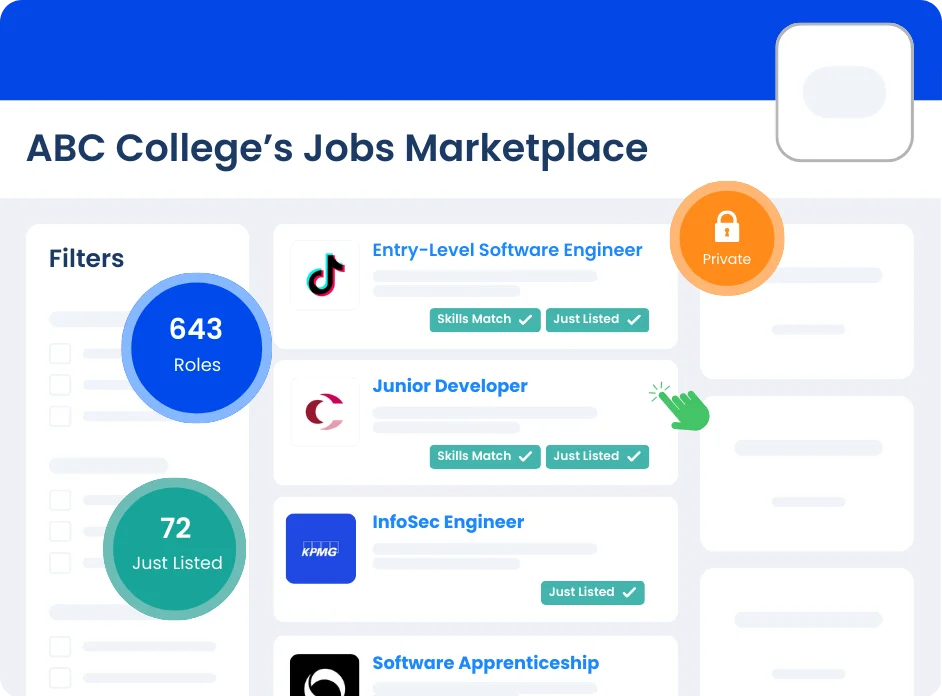
Spacewalk gives your college a private, branded job board, so career services can spend time coaching students rather than sourcing and re-listing vacancies.
Build your branded Spacewalk job board and invite your talent community in minutes
Whether you choose to stream roles automatically, invite employers or post them yourself they are automatically matched to your talent pool
Track applications, placements and community engagement from one reporting dashboard
Unlike generic job boards, Spacewalk gives you a branded, private or public jobs marketplace your talent actually trust, with sourcing, matching and reporting running automatically in the background.
Public colleges are typically governed by their province's public-sector privacy law (for example FIPPA in Ontario, the Access to Information and Protection of Privacy Act in Newfoundland and Labrador, or Quebec's public-sector privacy regime). Where colleges act as private-sector organisations or engage private service providers, the federal Personal Information Protection and Electronic Documents Act (PIPEDA) sets out ten fair information principles that cover consent, purpose limitation and safeguards (source: Office of the Privacy Commissioner of Canada, PIPEDA in brief). Quebec, British Columbia and Alberta each have substantially similar provincial private-sector privacy laws.
Emailing students and alumni about opportunities also engages Canada's anti-spam legislation, which requires consent, sender identification and a working unsubscribe in every commercial electronic message (source: Office of the Privacy Commissioner of Canada, Canada's anti-spam legislation). Right-to-work checks stay with the hiring employer, and roles surfaced to international students should be filtered against the conditions of their study or work permit rather than left generic. This is context, not legal advice.
This is an illustrative scenario, not a customer story. A Canadian polytechnic career services team stands up a branded job board for their business, health and applied technology programs and invites final-term students in the same week. Instead of forwarding email digests, coaches watch an employer-direct feed match each student to live, relevant roles by credential and campus. When the college's next KPI cycle asks for graduate employment evidence, the team exports landings by program rather than assembling ad-hoc spreadsheets.
With program-level data. Spacewalk tracks registrations, board usage, applications, interviews and landings by program and cohort, so career services can show what happened to graduates rather than reporting activity alone.
Yes. Roles are matched to each student's program, credential level and location, and your team can filter for employers who accept post-graduation work permit holders or co-op students.
Yes. Your students see your college's branding, not a generic job site, so the board sits naturally alongside your existing career services channels.
From an employer-direct stream of verified, active roles with direct apply links, matched to each student's program, credential level and location. Your team can also invite program-linked employers to post, but the vacancies are not scraped from job boards or aggregators.
No. Right-to-work verification stays with the hiring employer. Spacewalk connects students to live vacancies and tracks their progress.
It depends on your college. Public colleges are usually covered by the relevant provincial public-sector privacy law, while private-sector activity and service providers fall under PIPEDA or the substantially similar laws in Quebec, British Columbia and Alberta.
For the full product overview, see college careers offices job board software, the main product page for college careers offices worldwide.
Spacewalk supports post-secondary career services in comparable markets, including community and technical college career centers in the United States, university careers service software for UK institutions and Australian university careers offices.
Explore Spacewalk for Canadian university career services, Canadian alumni networks, Canadian skills bootcamps and Canadian outplacement services.
