August 1, 2026
















The Graduate Outcomes survey covered a target population of 1,002,175 graduates for the 2023/24 cohort, of whom 87% were in work or further study around 15 months after finishing their course (source: HESA, Graduate Outcomes 2023/24 Summary Statistics (SB275), 2026; source: HESA, Graduate Outcomes results, 2026). That single survey, run roughly 15 months after graduation, feeds Office for Students regulation, the Teaching Excellence Framework and public league tables, so a careers service's graduate outcomes are watched well beyond the campus. The constraint is rarely ambition, it is keeping graduates engaged and connected to genuine, still-open vacancies.
Graduate destinations in the UK are measured by a single sector-standard instrument: the Graduate Outcomes survey, run by HESA around 15 months after graduation (source: HESA, key principles of Graduate Outcomes, 2026). For the 2023/24 cohort, 87% of graduates were in work or further study and 81% were in employment or unpaid work at the 15-month point, from a target population of 1,002,175 graduates (source: HESA, SB275, 2026; source: HESA, Graduate Outcomes results, 2026). Those figures flow into OfS regulation and league tables, so for a careers service the measure that matters is not activity but where students actually land.
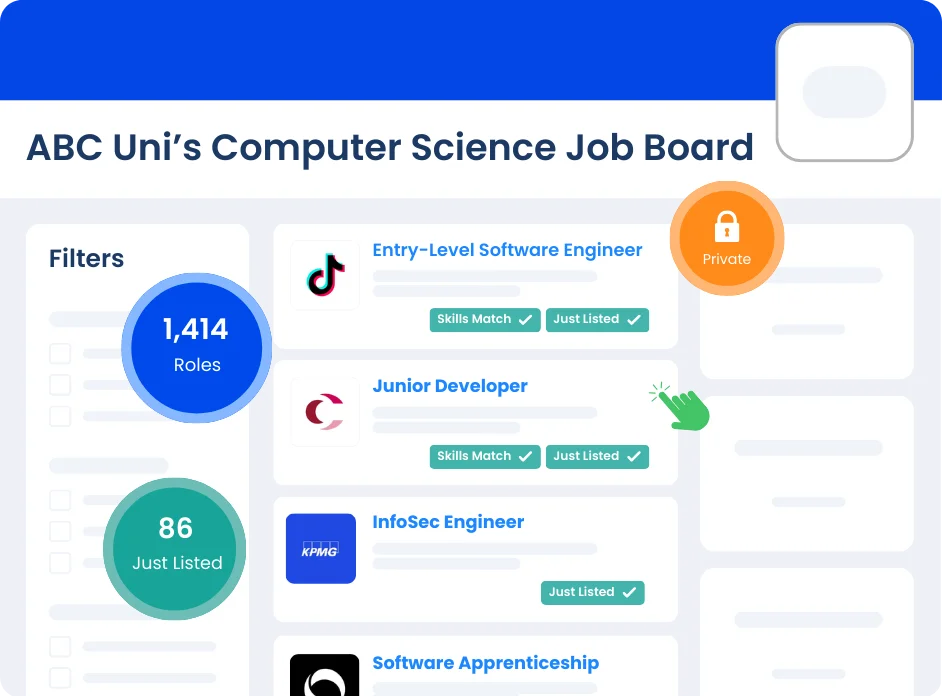
Spacewalk gives your careers service a private, branded job board, so your advisers spend their time guiding students rather than trawling job boards.
Build your branded Spacewalk job board and invite your talent community in minutes
Whether you choose to stream roles automatically, invite employers or post them yourself they are automatically matched to your talent pool
Track applications, placements and community engagement from one reporting dashboard
Unlike generic job boards, Spacewalk gives you a branded, private or public jobs marketplace your talent actually trust, with sourcing, matching and reporting running automatically in the background.
Universities are controllers of student and graduate personal data, so UK GDPR and the Data Protection Act 2018 apply in full, including the principles of lawfulness, fairness, transparency, purpose limitation, data minimisation and storage limitation across the student lifecycle (source: ICO, data protection principles, 2026).
Where a careers service shares student data with a third-party vacancies or careers platform, the ICO advises a data sharing agreement and a clear lawful basis, and any platform processing that data on the university's behalf becomes a processor expected to support a data processing agreement (source: ICO, data sharing, 2026). Right-to-work checks remain the hiring employer's responsibility, and student data should only ever be matched to genuine, employer-direct vacancies rather than passed to third-party aggregators. This is context, not legal advice.
This is an illustrative scenario, not a customer story. A UK university careers service stands up a branded job board and invites its final-year cohort before graduation. Instead of emailing job links, advisers watch an employer-direct feed match each student to live, relevant roles, and see application and interview activity by faculty. When the institution reviews its graduate outcomes against OfS thresholds, the careers service exports landings by cohort rather than assembling screenshots at the end.
By connecting students to genuine, live vacancies early and tracking what happens. Spacewalk records registrations, applications, interviews and landings per student, so the service can see who is progressing and focus support on those who have stalled, well before the 15-month Graduate Outcomes survey point.
For full-time first-degree provision the OfS sets a 60% progression threshold into high-skilled employment, further study or other positive outcomes, with thresholds across study modes ranging from 45% to 85%. Performance below a threshold is not automatically non-compliance, as the OfS considers context first.
Through the Graduate Outcomes survey, run by HESA around 15 months after graduation. It captures whether graduates are in employment, further study or other activity, and high-skilled work is defined using Standard Occupational Classification groups one to three.
From an employer-direct stream of verified, active roles with direct apply links, matched to each student's skills, level and location. Your team can also post roles or invite employers to post, but the vacancies are not scraped from job boards or aggregators.
No. Right-to-work verification stays with the hiring employer. Spacewalk connects students to live vacancies and tracks their progress.
UK GDPR and the Data Protection Act 2018. In practice that means a lawful basis, clear privacy information, data minimisation and defined retention periods, and a data sharing agreement where student data is shared with a third-party platform, in line with ICO guidance.
For the full product overview, see university careers offices job board software, the main product page for university careers offices worldwide.
Spacewalk supports university and college careers teams worldwide, including career center job board software in the United States, graduate employment platforms for Australian universities and careers service software for Canadian institutions.
Explore Spacewalk for alumni career platforms for UK institutions, UK employability programmes, UK skills bootcamps and UK professional associations.
