August 1, 2026




US institutions conferred roughly 5.1 million certificates and degrees in academic year 2021-22, including about 2.0 million bachelor's degrees (source: NCES, Condition of Education, Postsecondary Certificates and Degrees Conferred, 2021-22). Every graduating class compounds into an alumni base an office must serve for decades, and lifelong career support is one of the few benefits with clear, repeat value to a graduate. What alumni relations offices cannot rely on is a steady supply of genuine, still-open roles to put in front of that audience.
The addressable population is large and recurring: roughly 2.0 million new bachelor's-degree holders graduate each year (source: NCES, Condition of Education, 2021-22), and by 2024 about 40.1% of women and 37.1% of men age 25 and older held a bachelor's degree or higher (source: US Census Bureau, New Educational Attainment Data, 3 September 2025). The economic case that makes career support a durable alumni benefit is stark: median weekly earnings run about $946 for high school graduates versus $1,533 for bachelor's-degree holders and roughly $1,916 for advanced-degree holders (source: BLS, The Economics Daily, 2024). For an alumni office, the constraint is rarely audience, it is access to genuine, employer-direct roles to place people into.
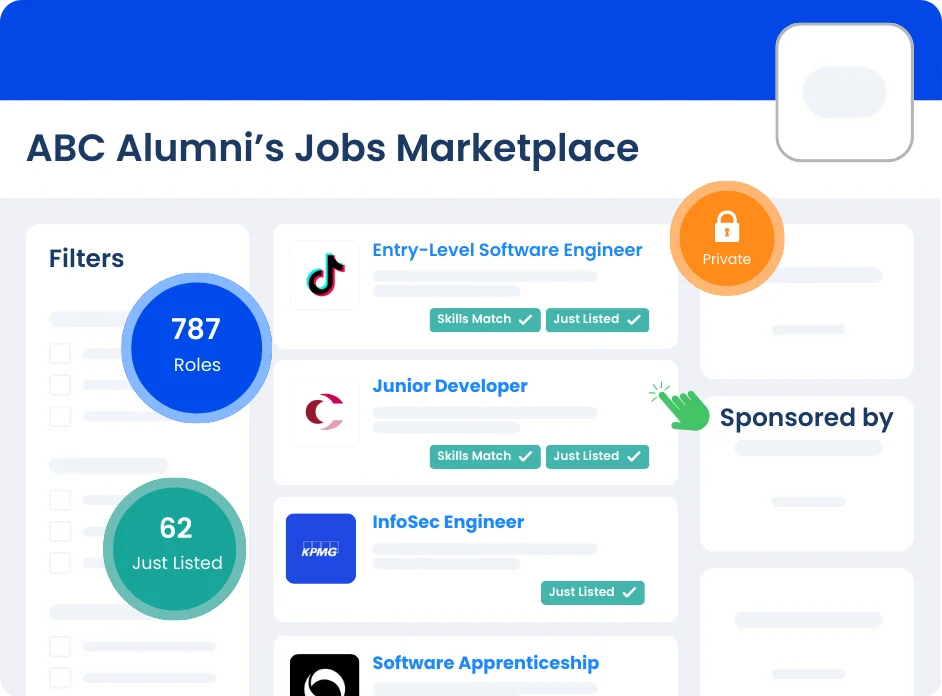
Spacewalk gives your alumni network a private, branded job board, so your team spends its time on engagement rather than trawling job boards.
Build your branded Spacewalk job board and invite your talent community in minutes
Whether you choose to stream roles automatically, invite employers or post them yourself they are automatically matched to your talent pool
Track applications, placements and community engagement from one reporting dashboard
Unlike generic job boards, Spacewalk gives you a branded, private or public jobs marketplace your talent actually trust, with sourcing, matching and reporting running automatically in the background.
Alumni contact and career data is personal information governed primarily by US state comprehensive privacy laws, led by California's CCPA (effective 1 January 2020) as amended by the CPRA (most provisions operative from 1 January 2023). By 2026 roughly 20 states have comprehensive privacy laws in effect, granting rights to access, correct, delete and opt out of sale or targeted advertising (source: IAPP, US State Comprehensive Privacy Laws overview, 2025).
FERPA protects "education records" a school maintains about a student (source: US Department of Education, What is an education record?). Information an alumni office collects about graduates after they leave generally falls outside that definition and under state consumer privacy law instead. Right-to-work verification stays with the hiring employer, not the job board, and candidate data should only be matched to genuine, employer-direct roles rather than passed to third-party aggregators. This is context, not legal advice.
This is an illustrative scenario, not a customer story. A US university alumni relations office stands up a branded job board and invites alumni across recent graduating classes. Instead of pointing people to LinkedIn, the career center watches an employer-direct feed match each alum to live, relevant roles, and sees application and interview activity. When advancement asks whether career services drives engagement, the office exports board usage and outcomes rather than assembling anecdotes.
With engagement data. Spacewalk tracks registrations, board usage, applications and interviews, so you can connect career-service activity to the engagement metrics advancement is measured on rather than a summary of events run.
Alumni already use free public platforms. A branded board earns a return visit only if it offers curated, trusted, relevant roles, which is why the vacancies are employer-direct and matched rather than scraped from aggregators.
Yes. Your alumni network gets its own branded board, so the experience carries your institution's brand rather than a generic job site.
From an employer-direct stream of verified, active roles with direct apply links, matched to each alum's skills, seniority and location. Your team can also post roles or invite employers to post, but the vacancies are not scraped from job boards or aggregators.
No. Right-to-work verification stays with the hiring employer. Spacewalk connects alumni to live roles and tracks their progress.
Primarily US state comprehensive privacy laws such as California's CCPA and CPRA. Alumni career and contact data collected after graduation generally falls under state privacy law rather than FERPA, which covers education records maintained about enrolled students.
For the full product overview, see alumni networks job board software, the main product page for alumni networks worldwide.
Spacewalk supports alumni networks and career services worldwide, including alumni career platforms for UK institutions, alumni job board software for Australian institutions and alumni career platforms for Canadian institutions.
Explore Spacewalk for US university career centers, US professional associations, US employability programs and US skills bootcamps.
