August 25, 2026














Youth outcomes have got harder to move. The seasonally adjusted proportion of 15 to 24 year olds not in employment, education or training rose to 13.8 percent in the September 2025 quarter, up from 12.9 percent in June 2025 (source: Stats NZ, Labour market statistics September 2025 quarter, 2025). The wider labour market has softened alongside, with seasonally adjusted unemployment at 5.2 percent in the June 2025 quarter and 158,000 people out of work (source: Stats NZ, Unemployment rate at 5.2 percent in the June 2025 quarter, 2025). Employability programmes now compete for a shrinking pool of live vacancies while their contracts hinge on sustained placements.
Youth NEET is the sector's core indicator. Stats NZ measures the share of 15 to 24 year olds not in employment, education or training every quarter through the Household Labour Force Survey, and it reached 13.8 percent in September 2025 (source: Stats NZ, Labour market statistics September 2025 quarter, 2025). Underneath sits a network of Ministry of Social Development programmes, including He Poutama Rangatahi for young people with complex barriers and Mana in Mahi's employer wage subsidy for young jobseekers, delivered by community and iwi organisations across the motu (sources: Work and Income, He Poutama Rangatahi, 2025; Ministry of Social Development, Young Adults, 2025). Their common bottleneck is access to real, current vacancies to place participants into, not the size of the cohort.
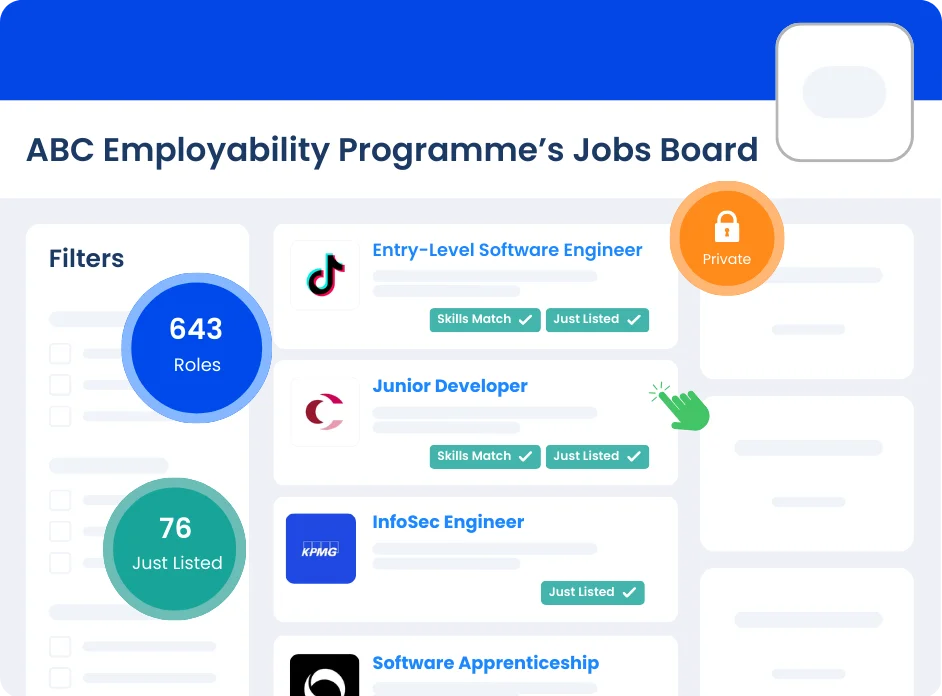
Spacewalk gives your programme a private, branded job board for participants, so coaches spend time with rangatahi rather than trawling public job boards for roles.
Build your branded Spacewalk job board and invite your talent community in minutes
Whether you choose to stream roles automatically, invite employers or post them yourself they are automatically matched to your talent pool
Track applications, placements and community engagement from one reporting dashboard
Unlike generic job boards, Spacewalk gives you a branded, private or public jobs marketplace your talent actually trust, with sourcing, matching and reporting running automatically in the background.
Participant information is regulated by the Privacy Act 2020 and its 13 Information Privacy Principles, administered by the Office of the Privacy Commissioner (source: Office of the Privacy Commissioner, Privacy Act 2020 principles). From 1 May 2026 a new principle, IPP 3A, adds a notification obligation when personal information is collected about a person from someone other than the person themselves (source: Office of the Privacy Commissioner, Privacy Act 2020 principles).
When coaches introduce rangatahi to employers, the OPC's recruitment guidance expects that applicant information stays with people directly involved, that referees are only contacted with consent and that unsuccessful applications are securely destroyed unless the participant agrees you can keep them on file (source: Office of the Privacy Commissioner, Privacy in recruitment). Right-to-work verification remains with the hiring employer. This is context, not legal advice.
This is an illustrative scenario, not a customer story. A New Zealand employability programme invites a new intake of rangatahi to a branded board on day one and captures their skills and location during onboarding. An employer-direct feed matches each participant to live vacancies, and coaches see who is applying and who has gone quiet. When the programme reports to its MSD contract manager, the team exports sustained landings by cohort instead of assembling notes from three different systems.
By tracking each participant end to end. Spacewalk records registrations, applications, interviews and landings by cohort, so your team can evidence sustained placements rather than only activity.
From an employer-direct job stream of verified, active roles with direct apply links, matched to each participant's skills and location. Your team can also post roles or invite employers to post, but the vacancies are not scraped from job boards or aggregators.
Yes. Your programme gets its own branded board, so participants see your identity rather than a generic job site.
No. Spacewalk sits alongside your case management as a branded job board and matching layer, so participants have a next step into work while your case notes stay where they are.
No. Right-to-work verification stays with the hiring employer. Spacewalk connects participants to live vacancies and tracks their progress.
The Privacy Act 2020 and its 13 Information Privacy Principles apply, and from 1 May 2026 IPP 3A adds a notification obligation for information collected about a participant from someone other than the participant. The Office of the Privacy Commissioner also publishes recruitment-specific guidance.
Spacewalk supports employability programmes across English-speaking markets, including Australian employability programmes, UK employability programmes and Irish employability programmes.
Explore Spacewalk for New Zealand private training establishments, New Zealand adult and community education providers, New Zealand university careers services and New Zealand outplacement services.
